
October 2026 newsletter
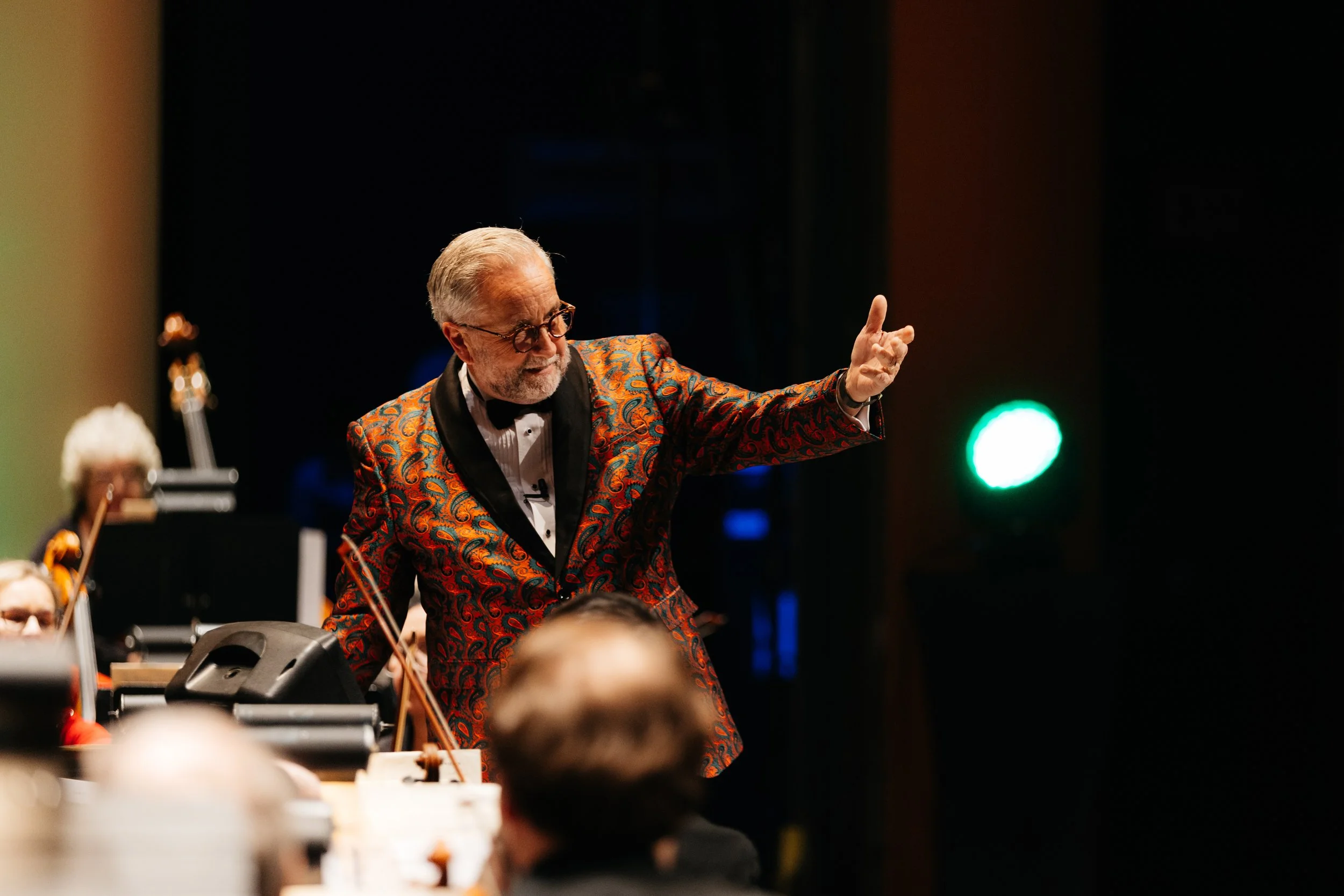
Center Stage: A Spotlight on the Last 50 Seasons
Written by Alison Theis
Meet the man behind the baton. Maestro Lauren Green has spent his golden years at the center of the stage with the Bartlesville Symphony Orchestra (BSO). Some may call it fate, destiny, or luck. But for Lauren, performing notable symphonic works is composed from one idea: If not now, when?
I had the distinct honor of getting to sit down with Maestro Green and gain an insight to the last fifty years. If you missed the pre-concert notes, here is a chance to catch what you missed.
The Man Behind the Baton:
Q: What inspired you to make a career out of music?
A: “I really don’t remember choosing between this or that. I always enjoyed music and was reasonably good at it. So once I majored in it, and got a couple of degrees, finding some sort of music job seemed like the logical next step. At that point I did know that I wanted to find somewhere to conduct. Eventually, Bartlesville Wesleyan College (now Oklahoma Wesleyan University) was looking for another music teacher and the BSO a new conductor. Since I had grown up in the Wesleyan church, the University took a risk on hiring a long-haired single Californian who definitely did not fit their mold. The BSO however, jumped at the chance to hire a new young conductor moving into town, even without a tryout or much of an interview. So in short, it was somewhat a matter of walking through open doors.”
Q: Do you have a favorite memory from your time conducting the Bartlesville Symphony orchestra?
A: “Well, that’s difficult, especially now that my memory is muddled with so many years under the bridge. There have been a number of exciting works, including Beethoven’s 9th and Carmina Burana. I’m really proud of a few innovative concert programs I devised; “Sound and Spirit” in 2009 stands out—a meaningful blend of poetry, projection, and music. Having incredible guest soloists was also special. The list of soloists that we had over the years still amazes me. Personal highlights would include Mel Tormé (twice) and conducting my lifelong cello teacher and her sister, Eleonore and Alice Schoenfeld, in Brahms’ Double Concerto in 1986. That was truly a special, full-circle experience.”
Q: To you personally, what does it mean to have been a conductor for 50 years with the symphony?
A: “This is a double-edged sword! It could mean that I planted musical seeds which I altruistically and devotedly nourished and developed over many years. I prefer to think that with my “choice” of career, being in one place for so long was a combination of circumstance, good luck, a great community, and a freedom to create music as I saw fit without many of the constraints faced by many other conductors.”
Q: Why is it such a big deal to have been with the same Symphony for 50 years?
A: “Well, most conductors have large ambitions to reach as high on the musical ladder as possible. I can’t say that I never had those ambitions or that I don’t even to this day. A conductor’s “success” will never stop being measured by the level of orchestra he/she conducts, or by how widely he/she is known. Whether by the public or in the conductor’s own mind. But there is also the definition of success that includes establishing a musical home, collaborating with several generations of musicians, and, honestly, simply having an orchestra that one can guide, experiment with, learn on, and return to year after year. The world is full of conductors who have everything going for them except one thing—an orchestra.”
A Legacy of Gold:
Q: What is your goal for this season?
A: “My mind kept coming back to the concepts of fate, destiny, serendipity, good luck, God’s will—whatever you want to call it, and there are several notable symphonic works which address this in some fashion. Some of these are very substantial works—like Tchaikovsky 4th and Beethoven 5th—that are certainly within the orchestra’s capabilities but still a big bite. But I figured if not now, then when?”
Q: What do you feel has been your greatest accomplishment within the BSO?
A: “That’s hard because it’s very subjective if not also self-serving. One thing, which is also a double-edged sword, is that I have tried fairly successfully to walk the tightrope between a 100% local volunteer community orchestra (where we started) and an orchestra that combines interested volunteers with paid professionals. This has been both for the sake of the players, but also for the audience. This is truly Bartlesville’s symphony. The challenge has been to keep everyone—players and audience, alike—happy and fulfilled. I think we’ve been fairly successful with that, even as the orchestra has continued to evolve in a more professional direction, with about 90% being paid professionals.”
Q: If you could go back to your first year as a conductor and give yourself some advice, what would it be?
A: “I look at some of the musical choices I made in my early years and wonder, ‘What was I even thinking?!’ I was very ambitious with my musical choices and expectations. Yet I am grateful that everyone put up with my naivety. But by the same token, my naively adventurous spirit led to many good things and exciting growth. So overall, I did the best I knew how to do and I’m thankful for how it turned out.”
Q: What is the best piece of advice another musician has ever given you?
A: “The interesting thing about my career is that I had few real mentors along the way. For better or worse I’ve pretty much learned on the job. I only studied conducting in graduate school, and my teacher had never taught conducting before. My cello teacher, Eleonore Schoenfeld, was a huge influence. I studied with her from elementary school through graduate school. While I was not one of her star students, she very wisely guided me to a smaller college where I gained tons of real musical experience which I would never have gotten if I had tried to attend some fancy conservatory like USC, where she also happened to teach. Herbert Blomstedt, with whom I studied for several summers early on, simply told me to ‘just settle down on the podium and stop bending my legs and gyrating needlessly.’ His teaching, conducting, and integrity both on and off the podium, stay with and influence me to this day.”
The last fifty seasons have taken Lauren Green through many journeys, both in his personal life and his professional one. It seems as though every conductor dreams of having their name revered in the music hall like Bernstein or Karajan. Or perhaps every performer to take the stage would rather be remembered for giving every audience a life-changing performance. Where each performance is accompanied by an eloquent speech, or turn of phrase that touches the hearts of the audience. But for Bartlesville’s Maestro the answer is simple. “I hope to be remembered as a fairly nice and reasonable person who had an obsession with finding and sharing cool music with whoever would listen, and who was given an extraordinary opportunity to do so for 50 years with an enthusiastic orchestra in an incredible concert hall and in a unique and supportive community.”